

4K Monitors: Can you actually see the difference?
With 4K monitors becoming more and more affordable, it appears that the long-standing reign of 1080p may finally exist coming to a close. The question is: can the homo eye actually see the divergence with a 4K monitor or are manufacturers but using the hype to sell you a more expensive product?
While this sounds like an easy question, unfortunately information technology does not have a completely clear-cutting reply. Different people have different eyesight quality, and both the size of a monitor and the viewing distance between the monitor and a person's eyes brand a huge divergence. In guild to accurately answer whether a 4K monitor is going to look any better than a lower resolution monitor, we will need to determine the pixel pitch (which is the distance between the pixels) of a monitor and compare information technology to what you are really capable of seeing.
Editor's Note:
Matt Bach is the head of Puget Labs and has been office of Puget Systems, a boutique builder of gaming and workstation PCs, since the early on days. This article was originally published on the Puget blog.
To practice this, we only demand a bit of math and four pieces of information:
- The size of the monitor
- The resolution of the monitor
- Your visual vigil (xx/twenty, 20/15, etc.)
- The altitude between your eyes and the monitor (viewing distance)
While the math in this article isn't terribly difficult, if you don't desire to feel like you are back in high school math class we've likewise put together an piece of cake to use Google Spreadsheet. In this spreadsheet you tin simply enter the relevant information and it will tell you lot the pixel pitch of a monitor and the pixel pitch you are actually able to come across. With this, you can decide if you are physically capable of seeing the divergence with a 4K monitor or if you should use a cheaper, lower resolution monitor instead.
Determining the pixel pitch of a monitor
The first task we need to accomplish is to decide the pixel pitch (or the distance between pixels) of any monitor you are interested in - whether it is one you already own or one y'all are considering purchasing. If you are lucky, the manufacturer volition but have this information included in the specs of the monitor. If they don't (or if yous don't trust that they didn't pad the number a bit) you can determine the pixel pitch based on the resolution and physical screen size.
There are many different ways to piece of work this out, but the method we prefer is to first determine the diagonal resolution of the monitor and then relate that to the physical screen size. To find the diagonal resolution, nosotros need to utilise the Pythagorean Theorem (a²+b²=c²).
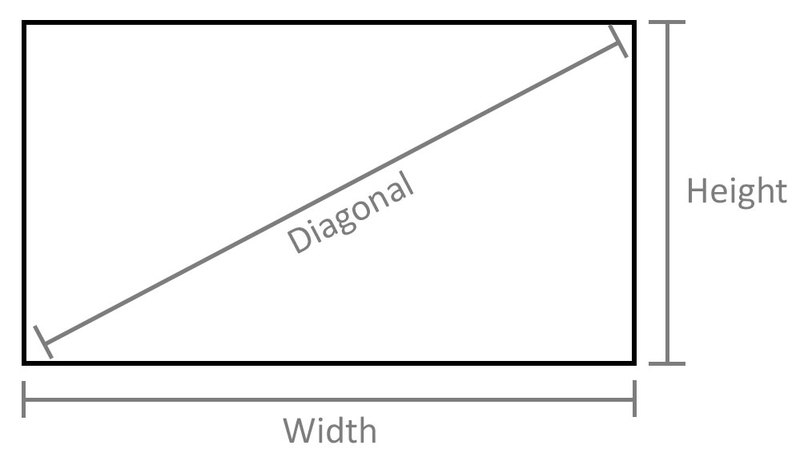
In our example, the formula to determine the diagonal is:

For a 4K screen, the calculation would be which works out to a diagonal resolution of most 4406. With this, we can discover the PPI (pixels per inch) of the monitor past determining the ratio between it and the physical screen size in inches (which is the diagonal measurement of the screen):
For a 31.5 inch monitor we would use the adding 4406/31.5 which gives u.s. a PPI of about 140. To get the pixel pitch in mm (which is what almost marketing uses), you need to catechumen from how many pixels there are in an inch to the distance between the pixels. Since there are 25.four mm in an inch, we can too convert to millimeters at the aforementioned time with the formula:
For our example 31.five" screen that has a PPI of 140, this translates to a pixel pitch of about .182mm
What resolution can the human heart see?
Asking what resolution the human center tin can see is really a bit inaccurate as the homo eye does not see a fixed resolution. Instead, human vision is measured based on angular resolution which is how far autonomously two objects need to exist for you to be able to tell them apart at a certain distance. In terms that we are familiar with, this looks like:
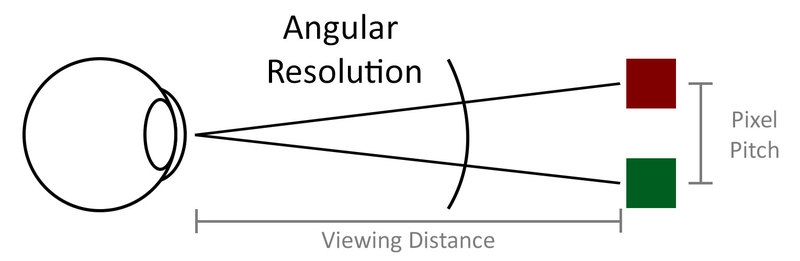
We accept already worked out how to determine the pixel pitch of a monitor, so the trick at present is to determine the pixel pitch yous are able to actually see at whatever distance you sit down away from your monitor. To practice this, we first need to decide your angular resolution based on your visual acuity.
For a person with xx/xx vision (using the Snellen nautical chart) your angular resolution works out to be one arc infinitesimal which is nigh .017° or .000296706 radians. However, since not everyone has exactly xx/20 vision, you tin can decide the angular resolution for any visual acuity (twenty/10, 20/40, etc.) with the very but formula:
And so a person with 20/10 vision would use the calculation: which gives a result of .5 arc minutes. We need to catechumen this into radians and since there are about 0.000290888 radians in an arc minute nosotros need to use the formula:
For a person with twenty/10 vision (or .v arc minutes), this translates to .000145444 radians. With the angular resolution in radians, we tin can then make up one's mind the pixel pitch you are able to see at a set altitude. To do this, we demand to use part of SOHCAHTOA:
In order to properly use this formula, we demand to actually use just one-half of the angular resolution (in order to keep the viewing altitude and pixel pitch at a right angle) then multiply the issue by two to get the full pixel pitch. Taking this into account, we can re-arrange this formula into:
This is still in inches, however, and then if we besides wanted to convert to a pixel pitch in mm we simply need to multiply past 25.four since there are 25.4 millimeters in an inch:
With this formula, a person with twenty/20 vision who likes to have their monitor 24 inches from their eyes would use the calculation:
This works out to a pixel pitch of about .177mm. If we would rather remember in terms of PPI (pixels per inch), we simply need to accept the changed and convert dorsum to inches by multiplying by 25.four:
In our case, this works out to about 144 PPI. In other words, a person with 20/20 vision who likes to have their monitor 24 inches away would ideally want a monitor that has a pixel pitch of less than .177 mm (or more than than 144 PPI).
If you lot can't get the math to work out properly (or want to exist able to easily check multiple resolutions and monitor sizes), feel free to use the Google Spreadsheet nosotros created that has all of the math automatic for yous.
Conclusion
Now that we know how to decide the PPI or pixel pitch your eyes are really able to run into at certain viewing distances, we can come up up with a basic chart showing the platonic maximum size of a monitor for different resolutions based on your visual acuity:
| Platonic maximum monitor size for 24" viewing altitude | 20/30 | twenty/20 | xx/15 | twenty/x |
|---|---|---|---|---|
| 1080p (1920x1080) | 23" | 15" | xi.five" | 7.5" |
| 2K (2560x1440) | 30.5" | 20" | fifteen.5" | ten" |
| 4K (3840x2160) | 46" | 30.5" | 23" | 15.v" |
| 5K (5120x2880) | 61.5" | 41" | 31" | xx.5" |
At a viewing distance of 24 inches (which is about correct for most desktop monitors) it is really really surprising how presently you lot should be able to start making out individual pixels with a 1080p monitor. With 20/20 vision, if you desire a monitor that is larger than but xv inches y'all would ideally want a monitor with a 2K resolution instead of 1080p. Even with a 2K monitor, however, one time you get to a higher place a twenty inch screen you should starting time to meet a difference past using a 4K monitor. Betwixt a 20 inch screen and a 30.v inch screen in that location is no reason to get above 4K, simply if you lot desire a very large monitor you may consider using a 5K monitor once the applied science matures a chip more.
However, the boilerplate acuity for a healthy adult nether the age of sixty or lxx is actually closer to between 20/13 and 20/17 (source i and two). So if you are average and healthy, you should accept a visual acuity of around 20/15 at which betoken the need for a higher resolution is even greater. At that visual acuity, for anything larger than a 15.five inch screen you would ideally desire to take a 4K screen. Only even with just a 23 inch monitor, even 4K technically isn't good plenty for your eyesight. 5K, which is still in its infancy, is really what you would ideally want for any monitor between 23 inches and 31 inches. For even larger screen sizes, you will have to wait for 6K or fifty-fifty higher resolutions to become available.
| Ideal maximum monitor size for 24" viewing altitude | 20/30 | 20/20 | 20/15 | twenty/10 |
|---|---|---|---|---|
| 1080p (1920x1080) | 21" | xiv" | x.v" | seven" |
| 2K (2560x1440) | 28" | 18.5" | fourteen" | 9" |
| 4K (3840x2160) | 42" | 28" | 21" | 14" |
| 5K (5120x2880) | 57" | 37.5" | 28" | 18.5" |
Moving in only two inches isn't much, but nosotros constitute that this is about right for the average laptop user when sitting at a desk. Of course, this will alter from user to user, but we arrived at this based on our very scientific method of sitting different employees in front of a laptop with a record measure.
At this distance, the need for 4K is very apparent. If yous have average vision (which as we stated earlier is actually around 20/15 for a good for you adult), yous would ideally want a 4K monitor at anything above a fourteen" screen size. This means that from a xiv" laptop on upwardly, the average healthy developed would ideally want to have a 4K screen. At the aforementioned time, unless you have 20/10 vision there should be no need for annihilation above a 4K screen on a laptop - so at to the lowest degree in terms of resolution a 4K screen is likely all laptops will always need.
Remember that both of these charts are generalizations. If you like to have your monitor either closer or farther abroad (or know more precisely your visual vigil) feel free to employ our Google Spreadsheet to experiment with different monitor sizes, distances, or visual acuity.
Now that we have all this figured out, we can effort to reply the question: is there a benefit to having a 4K monitor? For desktop monitors, the respond is very articulate: yep! Even a person with simply 20/20 vision should exist able to see the difference on whatsoever monitor larger than simply 20 inches in size and the difference becomes greater and greater for larger monitors. Laptops with much smaller screens are a bit less clear-cutting only the answer is notwithstanding a firm "yeah". For the boilerplate healthy adult with 20/fifteen vision, you should be able to easily tell the difference betwixt a 2K and 4K xv.6" screen at a distance of 22 inches. And if the choice is between a 1080p screen and a 4K screen (which are usually the two resolutions found on current laptops), 4K will be noticeably meliorate at a viewing altitude of 32.5 inches or closer. If you accept 20/20 or worse vision the departure might not as noticeable unless y'all sit down closer to the laptop, but in full general the math says that there is definitely a benefit to having a 4K screen even in a laptop.

Source: https://www.techspot.com/article/1113-4k-monitor-see-difference/
Posted by: daywayage.blogspot.com
0 Response to "4K Monitors: Can you actually see the difference?"
Post a Comment